Sermon on Knowing Who You Are
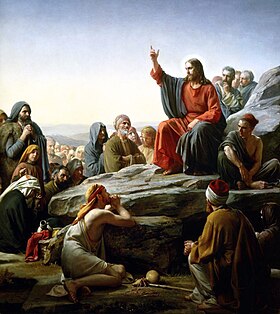
The Sermon on the Mount (anglicized from the Matthean Vulgate Latin section title: Sermo in monte ) is a collection of sayings and teachings attributed to Jesus Christ, which emphasizes his moral teaching found in the Gospel of Matthew (capacity 5, 6, and 7).[1] [2]
It is the first of the V Discourses of Matthew and takes identify relatively early in the Ministry of Jesus, afterwards he has been baptized by John the Baptist, finished his fasting and spiritual retreat in the desert, and begun to preach in Galilee. The name and location of the mountain is unstated; the Mount of Beatitudes, a hill on the shore of Lake Galilee is the traditional interpretation.
The Sermon is the longest continuous discourse of Jesus found in the New Testament, and has been one of the most widely quoted elements of the Canonical Gospels.[iii] It includes some of the all-time-known teachings of Jesus, such as the Beatitudes, and the widely recited Lord's Prayer. The Sermon on the Mountain is generally considered to contain the primal tenets of Christian discipleship.[3]
Background and setting [edit]
The Sermon on the Mount occupies chapters 5, six and 7 of the Gospel of Matthew. The Sermon has been ane of the most widely quoted elements of the Canonical Gospels.[iii]
This is the first of the 5 Discourses of Matthew, the other four being Matthew 10, Matthew 13 (1–53), Matthew 18 and the Olivet discourse in Matthew 24.[iv] [5] [6]
The Sermon is set early in the Ministry of Jesus after he has been baptized by John the Baptist in affiliate 3 of the Gospel of Matthew, gathered his first disciples in chapter four, and had returned from a long fast and contemplation in the Judaean Desert where he had been tempted by Satan to renounce his spiritual mission and gain worldly riches.
Before this episode, Jesus had been "all about Galilee" preaching, every bit in Matthew 4:23, and "slap-up crowds followed him" from all around the area. The setting for the sermon is given in Matthew 5:one-2. Jesus sees the multitudes, goes up into the mount, is followed by his disciples, and begins to preach. The Sermon is brought to its shut by Matthew viii:i,[7] which reports that Jesus "came down from the mountain followed past great multitudes".
Components [edit]
While the upshot of the exact theological structure and composition of the Sermon on the Mountain is subject to fence among scholars, specific components within it, each associated with particular teachings, can exist identified.[eight] [9]
Matthew 5:3–12[10] discusses the Beatitudes. These draw the character of the people of the Kingdom of Heaven, expressed as "blessings".[xi] The Greek word well-nigh versions of the Gospel return as "blessed," can as well be translated "happy" (Matthew 5:3–12 in Young's Literal Translation[12] for an instance). In Matthew, at that place are eight (or nine) blessings, while in Luke there are four, followed past four woes.[xi]
In virtually all cases the phrases used in the Beatitudes are familiar from an Quondam Testament context, simply in the sermon Jesus gives them new pregnant.[13] Together, the Beatitudes nowadays a new prepare of ideals that focus on love and humility rather than force and mastery; they echo the highest ideals of Jesus' teachings on spirituality and compassion.[13]
In Christian teachings, the Works of Mercy, which have corporal and spiritual components, have resonated with the theme of the Beatitude for mercy.[fourteen] These teachings emphasize that these acts of mercy provide both temporal and spiritual benefits.[15]
Matthew 5:13–16[16] presents the metaphors of salt and lite. This completes the profile of God's people presented in the beatitudes and acts every bit the introduction to the adjacent section.
There are two parts in this section, using the terms "salt of the world" and Light of the World to refer to the disciples – implying their value. Elsewhere, in John 8:12,[17] Jesus applies 'Light of the World' to himself.[eighteen]
Jesus preaches about Hell and what Hell is like: "Only I say unto y'all, That whosoever is angry with his brother without a cause shall be in danger of the judgment: and whosoever shall say to his brother "Raca (fool)" shall be in danger of the council: just whosoever shall say, Thou fool, shall be in danger of hell burn."[xix] However, the original translation of this verse refers to the real life location of Gehenna, a burial ground for the wicked, and not a place of spiritual torment.[ citation needed ]

The longest discourse in the Sermon is Matthew 5:17–48,[20] traditionally referred to as "the Antitheses" or "Matthew'south Antitheses". In the soapbox, Jesus fulfils and reinterprets the Old Covenant and in particular its X Commandments, contrasting with what "you have heard" from others.[21] For case, he advises turning the other cheek, and to love one's enemies, in contrast to taking an eye for an center. According to most interpretations of Matthew 5:17, 18, nineteen, and 20, and most Christian views of the Quondam Covenant, these new interpretations of the Police force and Prophets are not opposed to the Old Attestation, which was the position of Marcion, simply form Jesus' new teachings which bring nigh salvation, and hence must be adhered to, as emphasized in Matthew vii:24–27[22] towards the end of the sermon.[23]
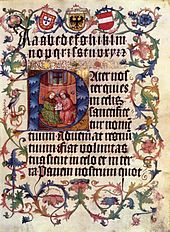
In Matthew six, Jesus condemns doing what would normally be "skilful works" simply for recognition and non from the heart, such equally those of alms (half-dozen:1–iv), prayer (6:5–fifteen), and fasting (6:sixteen–18). The discourse goes on to condemn the superficiality of materialism and calls the disciples not to worry well-nigh material needs, but to "seek" God's kingdom first. Within the discourse on ostentation, Matthew presents an example of correct prayer. Luke places this in a different context. The Lord's prayer (half-dozen:9–13) contains parallels to 1 Chronicles 29:10–eighteen.[24] [25] [26]
The first function of Matthew 7 (Matthew 7:1–half-dozen)[27] deals with judging. Jesus condemns those who judge others before first judging themselves: "Judge not, that ye be not judged."
Jesus concludes the sermon in Matthew 7:17–29Matthew 7:17-29</ref> by warning against false prophets.
Teachings and theology [edit]

The teachings of the Sermon on the Mount have been a key element of Christian ethics, and for centuries the sermon has acted as a key recipe for the comport of the followers of Jesus.[28] Various religious and moral thinkers (east.k. Leo Tolstoy and Mahatma Gandhi) have admired its message, and it has been one of the master sources of Christian pacifism.[1] [29]
In the 5th century, Saint Augustine began his book Our Lord's Sermon on the Mount by stating:
If anyone will piously and soberly consider the sermon which our Lord Jesus Christ spoke on the mount, equally we read information technology in the Gospel according to Matthew, I retrieve that he will find in information technology, so far every bit regards the highest morals, a perfect standard of the Christian life.
The last poesy of chapter v of Matthew (Matthew 5:48)[thirty] is a focal point of the Sermon that summarizes its teachings by advising the disciples to seek perfection.[31] The Greek word telios used to refer to perfection also implies an end, or destination, advising the disciples to seek the path towards perfection and the Kingdom of God.[31] It teaches that God's children are those who act like God.[32] [ meliorate source needed ]
The teachings of the sermon are often referred to as the "Ethics of the Kingdom": they place a high level of accent on "purity of the heart" and embody the basic standard of Christian righteousness.[33]
Theological structure [edit]
The theological structure of the Sermon on the Mount is widely discussed.[viii] [9] [34] One group of theologians ranging from Saint Augustine in the 5th century to Michael Goulder in the 20th century, encounter the Beatitudes as the key element of the Sermon.[8] Others such equally Günther Bornkamm meet the Sermon arranged around the Lord'south prayer, while Daniel Patte, closely followed by Ulrich Luz, run across a chiastic construction in the sermon.[8] [9] Dale Allison and Glen Stassen have proposed a structure based on triads.[9] [34] [35] Jack Kingsbury and Hans Dieter Betz see the sermon as equanimous of theological themes, e.yard. righteousness or manner of life.[viii]
Estimation [edit]

The high ethical standards of the Sermon take been interpreted in a wide diverseness of means by dissimilar Christian groups.
Northward American Biblical scholar Craig S. Keener finds at least 36 different interpretations of the message of the Sermon which he groups into 8 views:[36]
- The predominant medieval view, "reserving a higher ethic for clergy, especially in monastic orders"[37]
- A view associated with Martin Luther that information technology represents an impossible need, merely serves to educate Christians on the ideals of their faith[38]
- The Anabaptist a literal view which directly applies the teachings[39]
- The Social Gospel view[ description needed ]
- The Christian existentialism view[ clarification needed ]
- Schweitzer's view of an imminent eschatology referring to an interim ethic
- Dispensational eschatology which refers to the future Kingdom of God
- Inaugurated eschatology in which the Sermon's ethics remain a goal to exist approached, notwithstanding realized later
Comparison with the Sermon on the Evidently [edit]
While Matthew groups Jesus' teachings into sets of similar fabric, the same material is scattered when found in Luke.[1] The Sermon on the Mount may be compared with the similar but shorter Sermon on the Plain equally recounted by the Gospel of Luke (Luke six:17-49),Luke six:17–49 which occurs at the same moment in Luke's narrative, and as well features Jesus heading up a mount, just giving the sermon on the manner downwardly at a level spot. Some scholars believe that they are the aforementioned sermon, while others hold that Jesus frequently preached similar themes in different places.[40]
According to the Perennial Philosophy [edit]
According to perennialist author Frithjof Schuon, the message of the Sermon is a perfect synthesis of the whole Christian tradition. The text has the largest number of perennial and universal doctrines and spiritual advice of all Scripture. Much of what Bible readers think from Scripture derives from the Sermon. The source of spiritual and moral instructions, the Sermon on the Mountain is regarded by the Perennial Philosophy "as the quintessence itself of religion".[41] Perennialism considers the injunctions of the Sermon on the Mount as belonging to the esoteric dimension of Christianity.
Come across also [edit]
- Gospel harmony
- Jesus in Christianity
- Life of Jesus in the New Testament
- The Kingdom of God Is Inside You, 1894 Leo Tolstoy book
References [edit]
Citations [edit]
- ^ a b c Cantankerous, F.L., ed. (2005), "Sermon on the Mount", The Oxford dictionary of The Christian church, New York: Oxford University Printing .
- ^ Baasland, Ernst (2015). Parables and Rhetoric in the Sermon on the Mountain: New Approaches to a Classic Text. Tübingen, DE: Mohr Siebeck. ISBN9783161541025.
- ^ a b c Vaught, Carl G. (2001), The Sermon on the mount: a theological investigation, ISBN978-0-918954-76-3 . pages xi–fourteen.
- ^ The Cradle, the Cantankerous, and the Crown: An Introduction to the New Attestation by Andreas J. Köstenberger, L. Scott Kellum 2009 ISBN 978-0-8054-4365-3 pp. 94–96.
- ^ The Gospel of Matthew by Craig S. Keener 2009 ISBN 978-0-8028-6498-seven pp. 37–38.
- ^ Preaching Matthew'southward Gospel by Richard A. Jensen 1998 ISBN 978-0-7880-1221-1 pp. 25, 158.
- ^ Matthew 8:1
- ^ a b c d e Reading the Sermon on the Mount: by Charles H. Talbert 2004 ISBN i-57003-553-nine pp. 21–26.
- ^ a b c d What are they saying about Matthew's Sermon on the mount?, Warren Carter 1994 ISBN 0-8091-3473-X pp. 35–47.
- ^ Matthew 5:3–12
- ^ a b "Beatitudes." Frank Leslie Cross, Elizabeth A. Livingstone, eds. The Oxford dictionary of the Christian church building. New York: Oxford University Press. 2005 ISBN 978-0-19280290-three
- ^ Matthew v:3–12
- ^ a b A Lexicon of The Bible, James Hastings 2004 ISBN 1-4102-1730-2 pages 15–19.
- ^ Jesus the Peacemaker, Carol Frances Jegen 1986 ISBN 0-934134-36-7 pages 68–71.
- ^ The Synoptics: Matthew, Mark, Luke, Ján Majerník, Joseph Ponessa, Laurie Watson Manhardt 2005 ISBN i-931018-31-vi, pages 63–68
- ^ Matthew five:13–16
- ^ John 8:12
- ^ Spear, Charles (2003). Names and Titles of the Lord Jesus Christ. p. 226. ISBN0-7661-7467-0.
- ^ Matthew 5:22
- ^ Matthew 5:17–48
- ^ Meet David Flusser, "The Torah in the Sermon on the Mountain" (WholeStones.org) and idem, "'Information technology Is Said to the Elders': On the Estimation of the Then-called Antitheses in the Sermon on the Mount" (JerusalemPerspective.com).
- ^ Matthew 7:24–27
- ^ France, R. T. (2007). The Gospel of Matthew. pp. 1118–9. ISBN978-0-80282501-8.
- ^ 1 Chronicles 29:10–xviii
- ^ Clontz, T.E. & J., The Comprehensive New Testament with complete textual variant mapping and references for the Dead Sea Scrolls, Philo, Josephus, Nag Hammadi Library, Pseudepigrapha, Apocrypha, Plato, Egyptian Book of the Dead, Talmud, Quondam Testament, Patristic Writings, Dhammapada, Tacitus, Epic of Gilgamesh, Cornerstone, 2008, p. 451, ISBN 978-0-9778737-one-5
- ^ Stevenson (2004), p. 198.
- ^ Matthew 7:1–6
- ^ The sources of Christian ideals by Servais Pinckaers 1995 ISBN 0-8132-0818-i page 134
- ^ For Tolstoy, see My Religion, 1885. cf. My Religion on Wikisource.
- ^ Matthew v:48
- ^ a b Vaught, Carl Thou. (1986). The Sermon on the Mount: A Theological Interpretation. SUNY Press. pp. 7–x. ISBN9781438422800.
- ^ Talbert, Charles H. (2010). "Matthew". Paideia: Commentaries on the New Testament. Baker Bookish. p. 78. ISBN9780801031922.
- ^ Christian ideals, problems and insights by Eṃ Stephan 2007 ISBN 81-8069-363-v.
- ^ a b Allison, Dale C. (September 1987). "The Structure of the Sermon on the Mount" (PDF). Periodical of Biblical Literature. 106 (iii): 423–45. doi:10.2307/3261066. JSTOR 3261066.
- ^ Stassen, Glen H. "The Fourteen Triads of the Sermon on the Mount." Journal of Biblical Literature, 2003.
- ^ Keener, Craig S. (2009). "The sermon's message". The Gospel of Matthew. pp. 160–2. ISBN978-0-8028-6498-vii.
- ^ Mahoney, Jack (February 2012). "Catholicism Pure and Simple". 2nd, 3rd, and fourth paragraphs.
The most widespread and notorious of these strategies was the double standard arroyo which developed past the fourth dimension of the Center Ages, requiring the sermon to be taken seriously past only some members of the Church.
{{cite web}}: CS1 maint: location (link) - ^ Cahill, Lisa Sowle (April 1987). "The Upstanding Implications of the Sermon on the Mount". Interpretation: A Journal of Bible and Theology. 41 (2): 144–156. doi:x.1177/002096438704100204. S2CID 170623512.
The notion that the Sermon is impossible of fulfillment, but has a pedagogical function, is usually associated with Martin Luther or, as Jeremias puts it, with "Lutheran orthodoxy." Still, Luther himself maintained that faith is active in works of dear and that it is precisely faith which loving service presupposes and of which it is a sign. For this reason, Jeremias' own hermeneutic of the Sermon carries through Luther'due south nigh central insights. The Sermon indicates a way of life which presupposes conversion; the Sermon'south portrayals of discipleship, while not literal prescriptions, create ideals and gear up burdens of proof for all concrete embodiments.
- ^ "Global Anabaptist Mennonite Encyclopedia Online (GAMEO)". kickoff paragraph.
Whereas Luther emphasized salvation by organized religion and grace lonely, the Anabaptists placed emphasis on the obedience of faith.
- ^ Ehrman 2004, p. 101
- ^ Mateus Soares de Azevedo, "Esoterism and exoterism in the Sermon of the Mountain". In: Sophia journal (vol. 15, Number 1, Summertime 2009)
Sources [edit]
- Augustine of Hippo (1885). . Ante-Nicene Christian Library, Volume VI. Translated by William Findlay. T. & T. Clark in Edinburgh.
- Fenlon, John Francis (1907). . In Herbermann, Charles (ed.). Catholic Encyclopedia. Vol. two. New York: Robert Appleton Company.
- Betz, Hans Dieter. Essays on the Sermon on the Mount. translations past Laurence Welborn. Philadelphia: Fortress Printing, 1985.
- Kasteren, Johannes Peter Van (1907). . In Herbermann, Charles (ed.). Cosmic Encyclopedia. Vol. 2. New York: Robert Appleton Company.
- Kissinger, Warren S. The Sermon on the Mount: A History of Interpretation and Bibliography. Metuchen: Scarecrow Press, 1975.
- Friedrich Justus Knecht (1910). . A Practical Commentary on Holy Scripture. B. Herder.
- Kodjak, Andrej. A Structural Assay of the Sermon on the Mount. New York: G. de Gruyter, 1986.
- Lapide, Pinchas. The Sermon on the Mountain, Utopia or Program for Action? translated from the German by Arlene Swidler. Maryknoll: Orbis Books, 1986.
- Lambrecht, Jan, S.J. The Sermon on the Mount. Michael Glazier: Wilmington, DE, 1985.
- McArthur, Harvey King. Understanding the Sermon on the Mount. Westport: Greenwood Press, 1978.
- Prabhavananda, Swami Sermon on the Mount According to Vedanta 1991 ISBN 0-87481-050-seven
- Easwaran Eknath. Original Goodness (on Beatitudes). Nilgiri Press, 1989. ISBN 0-915132-91-v.
- Stassen, Glen H., and David P. Gushee. Kingdom Ethics: Following Jesus in Contemporary Context, InterVarsity Press, 2003. ISBN 0-8308-2668-8.
- Stassen, Glen H. Living the Sermon on the Mount: A Applied Hope for Grace and Deliverance, Jossey-Bass, 2006. ISBN 0-7879-7736-5.
- Stevenson, Kenneth. The Lord's prayer: a text in tradition, Fortress Press, 2004. ISBN 0-8006-3650-3.
- Soares de Azevedo, Mateus. Esoterism and Exoterism in the Sermon of the Mount. Sophia journal, Oakton, VA, USA. Vol. 15, Number 1, Summer 2009.
- Soares de Azevedo, Mateus. Christianity and the Perennial Philosophy, Globe Wisdom, 2006. ISBN 0-941532-69-0.
External links [edit]
- Sermon on the Mountain equally heart of Gospel'due south Constabulary co-ordinate to the Catechism of the Catholic Church building.
- The Sermon on the Mount Site: Extensive range of Sermon on the Mount related resource
- Listen "Blessed are those who mourn" commentary
- The Sermon on the Mountain as depicted past Claude Lorrain at the Frick Collection in New York Urban center
- Read Christ Pedagogy the Beatitudes in the Americas in The Book of Mormon
Source: https://en.wikipedia.org/wiki/Sermon_on_the_Mount
0 Response to "Sermon on Knowing Who You Are"
Post a Comment