what is known as the ability to respond quickly and accurately to sensory stimuli?
What you'll larn to practise: differentiate between sensation and perception

Awareness and perception are two split up processes that are very closely related. Sensation is input about the physical earth obtained by our sensory receptors, and perception is the process by which the brain selects, organizes, and interprets these sensations. In other words, senses are the physiological basis of perception. Perception of the same senses may vary from 1 person to some other because each person'southward brain interprets stimuli differently based on that private'due south learning, retention, emotions, and expectations.
LEARNING OBJECTIVES
- Define sensation and explicate its connection to the concepts of absolute threshold, difference threshold, and subliminal messages
- Discuss the roles attention, motivation, and sensory adaptation play in perception
Awareness
What does it mean to sense something? Sensory receptors are specialized neurons that respond to specific types of stimuli. When sensory data is detected by a sensory receptor, sensation has occurred. For instance, light that enters the middle causes chemic changes in cells that line the back of the eye. These cells relay messages, in the course of activeness potentials (every bit you learned when studying biopsychology), to the key nervous arrangement. The conversion from sensory stimulus energy to activeness potential is known every bit transduction.
You have probably known since uncomplicated school that nosotros have v senses: vision, hearing (audition), smell (olfaction), taste (gustation), and touch on (somatosensation). Information technology turns out that this notion of five senses is oversimplified. We also have sensory systems that provide data about residue (the vestibular sense), body position and movement (proprioception and kinesthesia), pain (nociception), and temperature (thermoception).

Figure ane. The absolute threshold for detecting calorie-free is greater than y'all probably imagined—the man eye can meet a candle on a clear night upwards to 30 miles away!
The sensitivity of a given sensory organisation to the relevant stimuli can be expressed as an absolute threshold. Absolute threshold refers to the minimum corporeality of stimulus energy that must be present for the stimulus to exist detected 50% of the time. Another fashion to call up nigh this is by request how dim can a light be or how soft tin a sound exist and nonetheless be detected one-half of the time. The sensitivity of our sensory receptors can be quite astonishing. Information technology has been estimated that on a articulate night, the well-nigh sensitive sensory cells in the back of the eye tin can discover a candle flame thirty miles abroad (Okawa & Sampath, 2007). Under quiet conditions, the hair cells (the receptor cells of the inner ear) tin can detect the tick of a clock 20 anxiety away (Galanter, 1962).
It is as well possible for us to get letters that are presented beneath the threshold for conscious awareness—these are called subliminal letters. A stimulus reaches a physiological threshold when it is stiff plenty to excite sensory receptors and send nervus impulses to the brain: this is an absolute threshold. A message below that threshold is said to exist subliminal: nosotros receive it, merely nosotros are not consciously aware of it. Therefore, the message is sensed, but for any reason, it has non been selected for processing in working or short-term memory. Over the years in that location has been a great bargain of speculation nearly the use of subliminal messages in advert, stone music, and self-help audio programs. Research evidence shows that in laboratory settings, people can process and answer to information exterior of sensation. But this does not mean that we obey these letters similar zombies; in fact, hidden messages have little upshot on behavior outside the laboratory (Kunst-Wilson & Zajonc, 1980; Rensink, 2004; Nelson, 2008; Radel, Sarrazin, Legrain, & Gobancé, 2009; Loersch, Durso, & Trivial, 2013).
Dig Deeper: UnConscious Perception

Figure 2. Priming can be used to better intellectual test performance. Research subjects primed with the stereotype of a professor – a sort of intellectual part model – outperformed those primed with an anti-intellectual stereotype. [Photo: Jeremy Wilburn]
These days, almost scientific research on unconscious processes is aimed at showing that people do not need consciousness for certain psychological processes or behaviors. One such example is mental attitude formation. The most basic process of attitude formation is through mere exposure (Zajonc, 1968). Only perceiving a stimulus repeatedly, such as a make on a billboard 1 passes every day or a song that is played on the radio frequently, renders it more positive. Interestingly, mere exposure does not require conscious awareness of the object of an mental attitude. In fact, mere-exposure effects occur even when novel stimuli are presented subliminally for extremely cursory durations (e.one thousand., Kunst-Wilson & Zajonc, 1980). Intriguingly, in such subliminal mere-exposure experiments, participants indicate a preference for, or a positive attitude towards, stimuli they do not consciously remember existence exposed to.Some other example of modern inquiry on unconscious processes is research onpriming. Priming generally relies on supraliminal stimuli, which ways that the messaging may occur out of awareness, merely information technology is yet perceived, unlike subliminal messaging. Supraliminal messages are be perceived by the conscious mind. For example, in i study, shoppers listened to either French or High german music (the supraliminal messaging) while ownership vino, and sales originating from either country were higher when music from that aforementioned country was played overhead.[i]In a well-known experiment past a inquiry team led by the American psychologist John Bargh (Bargh, Chen, & Burrows, 1996), half the participants were primed with the stereotype of the elderly by doing a linguistic communication task (they had to make sentences on the basis of lists of words). These lists independent words commonly associated with the elderly (e.one thousand., "old," "bingo," "walking stick," "Florida"). The remaining participants received a language task in which the disquisitional words were replaced by words not related to the elderly. After participants had finished they were told the experiment was over, but they were secretly monitored to see how long they took to walk to the nearest elevator. The primed participants took significantly longer. That is, subsequently existence exposed to words typically associated with being erstwhile, they behaved in line with the stereotype of old people: being slow.Such priming furnishings have been shown in other domains besides. For example, Dijksterhuis and van Knippenberg (1998) demonstrated that priming tin can better intellectual performance. They asked their participants to reply 42 full general cognition questions taken from the game Piffling Pursuit. Under normal weather, participants answered about fifty% of the questions correctly. However, participants primed with the stereotype of professors—who are by most people seen as intelligent—managed to reply sixty% of the questions correctly. Conversely, performance of participants primed with the "dumb" stereotype of hooligans dropped to 40%. Both of these studies have had hard times replicating, and so information technology is worth noting that the conclusions reached may not be as powerful equally originally reported.
Absolute thresholds are mostly measured under incredibly controlled conditions in situations that are optimal for sensitivity. Sometimes, nosotros are more interested in how much difference in stimuli is required to find a departure between them. This is known every bit the just noticeable difference (jnd) or difference threshold. Unlike the absolute threshold, the difference threshold changes depending on the stimulus intensity. As an case, imagine yourself in a very dark picture palace. If an audition member were to receive a text message on her cell phone which caused her screen to light up, chances are that many people would notice the change in illumination in the theater. However, if the same thing happened in a brightly lit arena during a basketball game, very few people would detect. The cell phone brightness does not change, but its ability to be detected equally a change in illumination varies dramatically between the two contexts. Ernst Weber proposed this theory of change in departure threshold in the 1830s, and it has become known as Weber's law: The difference threshold is a constant fraction of the original stimulus, as the example illustrates. It is the idea that bigger stimuli require larger differences to be noticed. For case, it will be much harder for your friend to reliably tell the difference betwixt 10 and 11 lbs. (or 5 versus 5.5 kg) than it is for 1 and two lbs.
Try Information technology
Think It Over
Think about a time when yous failed to notice something effectually you lot because your attention was focused elsewhere. If someone pointed information technology out, were you surprised that y'all hadn't noticed it right away?
Perception
While our sensory receptors are constantly collecting data from the environs, it is ultimately how we interpret that information that affects how we interact with the world. Perception refers to the way sensory information is organized, interpreted, and consciously experienced. Perception involves both lesser-upwards and meridian-downward processing. Lesser-upward processing refers to the fact that perceptions are built from sensory input. On the other hand, how we translate those sensations is influenced by our available knowledge, our experiences, and our thoughts. This is called top-downward processing.
Expect at the shape in Figure 3 below. Seen lonely, your brain engages in bottom-up processing. There are two thick vertical lines and three thin horizontal lines. There is no context to give it a specific meaning, so there is no pinnacle-downwards processing involved.

Figure 3. What is this prototype? Without whatsoever context, you must apply bottom-up processing.
Now, look at the same shape in 2 dissimilar contexts. Surrounded by sequential letters, your encephalon expects the shape to be a letter and to consummate the sequence. In that context, you perceive the lines to class the shape of the letter "B."

Figure 4. With top-down processing, you use context to give pregnant to this image.
Surrounded by numbers, the same shape now looks like the number "13."

Effigy v. With top-down processing, you lot employ context to give meaning to this image.
When given a context, your perception is driven by your cognitive expectations. Now y'all are processing the shape in a peak-down fashion.
1 style to think of this concept is that awareness is a concrete process, whereas perception is psychological. For example, upon walking into a kitchen and smelling the scent of blistering cinnamon rolls, the awareness is the odor receptors detecting the odor of cinnamon, but the perception may be "Mmm, this smells similar the staff of life Grandma used to broil when the family gathered for holidays."
Although our perceptions are congenital from sensations, not all sensations result in perception. In fact, nosotros often don't perceive stimuli that remain relatively constant over prolonged periods of time. This is known as sensory accommodation. Imagine entering a classroom with an old analog clock. Upon first inbound the room, yous tin hear the ticking of the clock; every bit you begin to engage in chat with classmates or listen to your professor greet the class, you are no longer aware of the ticking. The clock is still ticking, and that data is still affecting sensory receptors of the auditory organisation. The fact that you no longer perceive the sound demonstrates sensory adaptation and shows that while closely associated, awareness and perception are dissimilar.
Effort Information technology
Attention and Perception
There is another gene that affects awareness and perception: attention. Attention plays a significant part in determining what is sensed versus what is perceived. Imagine you are at a party total of music, chatter, and laughter. Yous become involved in an interesting conversation with a friend, and yous tune out all the background racket. If someone interrupted you to ask what song had just finished playing, you would probably be unable to reply that question.
Lookout Information technology
See for yourself how inattentional blindness works by watching this selective attention test from Simons and Chabris (1999):
One of the most interesting demonstrations of how important attention is in determining our perception of the environment occurred in a famous study conducted past Daniel Simons and Christopher Chabris (1999). In this written report, participants watched a video of people dressed in black and white passing basketballs. Participants were asked to count the number of times the squad in white passed the ball. During the video, a person dressed in a black gorilla costume walks among the two teams. You would call back that someone would find the gorilla, correct? Nearly half of the people who watched the video didn't discover the gorilla at all, despite the fact that he was conspicuously visible for nine seconds. Considering participants were and so focused on the number of times the white team was passing the ball, they completely tuned out other visual information. Failure to notice something that is completely visible considering of a lack of attending is chosen inattentional blindness.
In a similar experiment, researchers tested inattentional incomprehension past asking participants to observe images moving across a figurer screen. They were instructed to focus on either white or black objects, disregarding the other color. When a blood-red cross passed across the screen, about i third of subjects did not observe it (Well-nigh, Simons, Scholl, & Chabris, 2000).
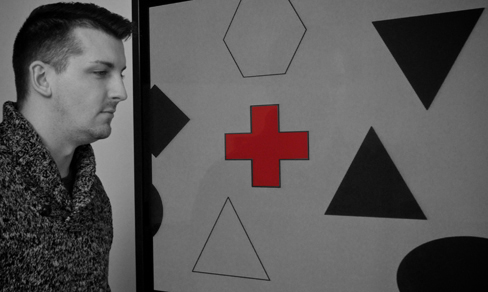
Figure 6. Nearly 1 third of participants in a study did not find that a cerise cantankerous passed on the screen considering their attention was focused on the blackness or white figures. (credit: Cory Zanker)
Motivations, Expectations, and Perception
Motivation tin too affect perception. Have yous ever been expecting a really important call and, while taking a shower, you lot think you hear the phone ringing, only to observe that it is not? If so, and then you have experienced how motivation to detect a meaningful stimulus tin can shift our ability to discriminate between a true sensory stimulus and background racket. The power to identify a stimulus when it is embedded in a distracting background is called signal detection theory. This might also explain why a mother is awakened by a quiet murmur from her infant but not by other sounds that occur while she is asleep. Signal detection theory has practical applications, such as increasing air traffic controller accuracy. Controllers demand to be able to detect planes among many signals (blips) that appear on the radar screen and follow those planes as they motion through the sky. In fact, the original work of the researcher who developed signal detection theory was focused on improving the sensitivity of air traffic controllers to plane blips (Swets, 1964).
Our perceptions tin can likewise exist afflicted by our beliefs, values, prejudices, expectations, and life experiences. As yous will see afterwards in this module, individuals who are deprived of the experience of binocular vision during disquisitional periods of evolution have trouble perceiving depth (Fawcett, Wang, & Birch, 2005). The shared experiences of people inside a given cultural context can have pronounced effects on perception. For example, Marshall Segall, Donald Campbell, and Melville Herskovits (1963) published the results of a multinational study in which they demonstrated that individuals from Western cultures were more prone to experience sure types of visual illusions than individuals from non-Western cultures, and vice versa. One such illusion that Westerners were more than likely to experience was the Müller-Lyer illusion: the lines appear to be dissimilar lengths, but they are really the same length.
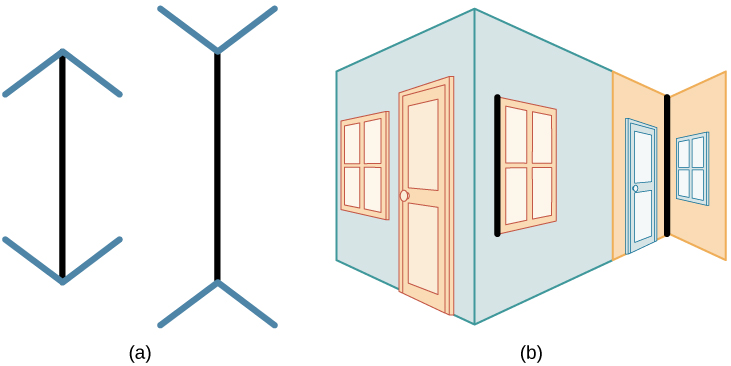
Figure 7. In the Müller-Lyer illusion, lines appear to exist different lengths although they are identical. (a) Arrows at the ends of lines may brand the line on the right appear longer, although the lines are the same length. (b) When applied to a 3-dimensional image, the line on the right over again may announced longer although both black lines are the aforementioned length.
These perceptual differences were consistent with differences in the types of environmental features experienced on a regular ground by people in a given cultural context. People in Western cultures, for example, take a perceptual context of buildings with directly lines, what Segall'due south study called a carpentered world (Segall et al., 1966). In contrast, people from certain non-Western cultures with an uncarpentered view, such as the Zulu of South Africa, whose villages are made up of round huts arranged in circles, are less susceptible to this illusion (Segall et al., 1999). It is non merely vision that is afflicted by cultural factors. Indeed, inquiry has demonstrated that the ability to identify an olfactory property, and charge per unit its pleasantness and its intensity, varies cantankerous-culturally (Ayabe-Kanamura, Saito, Distel, Martínez-Gómez, & Hudson, 1998).
Children described as thrill seekers are more likely to show gustation preferences for intense sour flavors (Liem, Westerbeek, Wolterink, Kok, & de Graaf, 2004), which suggests that basic aspects of personality might touch perception. Furthermore, individuals who concord positive attitudes toward reduced-fat foods are more than likely to charge per unit foods labeled as reduced fat as tasting better than people who have less positive attitudes about these products (Aaron, Mela, & Evans, 1994).
Lookout It
Review the differences betwixt sensation and perception in this CrashCourse Psychology video:
Try It
Think Information technology Over
Retrieve about a time when you failed to notice something around you because your attending was focused elsewhere. If someone pointed it out, were you lot surprised that you hadn't noticed information technology correct away?
Glossary
absolute threshold:minimum amount of stimulus energy that must be nowadays for the stimulus to be detected 50% of the time
bottom-up processing:system in which perceptions are built from sensory input
inattentional blindness:failure to observe something that is completely visible because of a lack of attention
but noticeable difference:difference in stimuli required to observe a deviation between the stimuli
mere-exposure effects: the consequence of developing a more positive attitude towards a stimulus afterwards repeated instances of mere exposure to it.
perception:way that sensory information is interpreted and consciously experienced
priming: the process by which recent experiences increase a trait's accessibility.
sensation:what happens when sensory information is detected by a sensory receptor
signal detection theory:change in stimulus detection as a function of electric current mental country
subliminal message:bulletin presented below the threshold of conscious awareness
elevation-downwards processing:interpretation of sensations is influenced past bachelor noesis, experiences, and thoughts
sensory adaptation: the reduction in sensitivity after prolonged exposure to a stimulus
transduction:conversion from sensory stimulus energy to activity potential
Weber'southward law: Ernst Weber's discovery that the difference threshold is a constant fraction of the original stimulus and bigger stimuli crave larger differences to be noticed
stillwellwhilich1964.blogspot.com
Source: https://courses.lumenlearning.com/wmopen-psychology/chapter/outcome-sensation-and-perception/
0 Response to "what is known as the ability to respond quickly and accurately to sensory stimuli?"
Post a Comment